
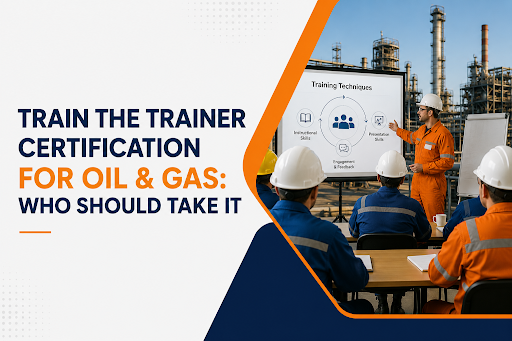
Oil and gas companies operate in some of the toughest environments in the world. The processes involved in any aspect of their operations require precision, adherence, and risk awareness. Given that such an environment requires high levels of efficiency, information sharing is not only crucial but mandatory. This is where train-the-trainer programs can be helpful to individuals tasked with training teams, organizing workshops, or ensuring workforce competence.
An oil and gas training specialist not only has to instruct on process operations. They need to communicate effectively, manage practical classes, deal with varied types of learners, and ensure that their workers comprehend operational risks. A certification process will enable them to learn all these skills.
Why Technical Expertise Alone Is Not Enough :
Many people who have worked for years in oil and gas become mentors or supervisors. While their technical knowledge is impressive, they lack some skills needed to train other professionals.
An experienced engineer or supervisor could know about the processes well. Still, passing on that knowledge requires:
- Clear communication methods
- Practical presentation skills
- Assessment and evaluation techniques
- Structured lesson planning
- Confidence in handling group discussions
- Safety-focused instruction methods
Lack of those abilities might hinder an engineer or supervisor from conducting an effective training session despite their extensive technical expertise.
The Growing Need for Skilled Trainers in Oil & Gas
Constant changes are occurring in the oil and gas industry. This is associated with technological innovations, the introduction of digital solutions, enhanced safety regulations, and environmental concerns. Additionally, there is an ongoing process of changing generations within companies since many experienced professionals are retiring and young workers are entering the business.
Thus, companies require certified trainers who can transfer knowledge effectively and quickly.
Modern training programs involve not only the provision of classroom lessons but also:
- Simulation-based training
- Drills in offshore safety
- Demonstrations of equipment handling
- Digitized safety training
- Emergency responses training
- Technical competence evaluations
Individuals who are able to carry out such initiatives are becoming increasingly important throughout the entire value chain: upstream, midstream, and downstream sectors.
Who Should Consider This Certification?
Certification will be particularly helpful for all professionals, irrespective of their function. It not only applies to dedicated corporate trainers.
Safety Officers and HSE Professionals
One of the most important aspects of operations in the oil and gas sector is ensuring safety. Often, HSE officers have to organize toolbox talks, inductions, emergency drills, and other training sessions. With certification, individuals will be better able to master the delivery process.
Supervisors and Team Leaders
Line supervisors are responsible for guiding new employees and overseeing operations. Having proper training skills helps to convey complex information to people in a clear and concise manner.
Technical Instructors
Professionals already engaged in conducting classes on equipment, drilling, machinery, and other operations will be able to improve their training techniques.
Marine and Offshore Personnel
The oil and gas sector has many offshore assets. People who work offshore have to be compliant with international standards on operations and safety. Certification will enable marine trainers to get acquainted with the latest training methods.
HR and Learning & Development Teams
The trend toward the use of internal departments for training within an organization continues. In this respect, the personnel engaged in such processes can benefit greatly from knowledge about specialized training techniques.
Skills Developed Through a Certification Program
Professional certification aims at boosting both teaching and leadership skills. Trainees tend to acquire a range of both practical and communicative skills.
Among others, some common areas are:
Training Design and Planning
Participants in a certification program tend to learn the basics of creating an effective session, specifying its goals, and designing appropriate content.
Presentation & Communication
As clear communication is crucial during discussions of technical procedures or safety protocols, trainers learn how to present information in an adequate manner.
Practical Demonstration Techniques
Since oil and gas training requires practical demonstration of equipment usage, participants receive knowledge about conducting such a process properly.
Assessment & Feedback Techniques
The trainers need to assess whether the participants have learned from the training. Assessment techniques are usually incorporated into programs to facilitate this process.
In the middle of evolving standards of operation, organizations tend to favor professionals with train-the-trainer certification due to their indication of knowledge of the topic and teaching ability.
How Certification Supports Operational Safety
The quality of the training affects the level of workplace safety. Misunderstood training instructions may cause errors and unsafe behavior at work.
Certified trainers will assist your organization to:
- Enhance competence among workers
- Decrease operational errors
- Establish a safety culture
- Prepare employees for emergencies
- Comply with international safety standards
- Boost worker confidence in high-risk environments
Where any error in the workplace could lead to dire results, it then becomes essential to incorporate proper training in the operations of the industry.
The Importance of Industry-Relevant Training
Not all training programs apply to workers in the energy sector. It is crucial to seek training certification that relates directly to your field of practice.
Oil and Gas practitioners need to look out for training programs that incorporate:
- Real-life case studies
- Both offshore and onshore operations
- Safety-oriented instruction
- Effective use of technical language
- International training programs
- Practical learning programs
Specialized programs targeting energy training tend to be more successful than the general corporate training certifications.
Adapting to Modern Workforce Learning
Employees today have different learning preferences. Young professionals, especially those joining the sector for the first time, tend to favor interactive and technology-based approaches rather than conventional classroom settings.
Current training requirements demand that modern trainers include:
- Visual learning tools
- Scenario-based instruction
- Digital presentations
- Interactive workshops
- Practical simulations
- Remote learning platforms
A certified trainer would be better able to adjust to such new demands without compromising efficiency and safety in operations.
Building Long-Term Career Opportunities
Certification may help develop long-term careers for individuals who aim to take up positions in senior roles, compliance, and training management.
Most employers seek people who not only possess technical skills but can also pass on that knowledge to other people. The resulting careers can be in the following areas:
- Corporate training departments
- Training centers offshore
- Technical institutions
- Safety consultants
- Competency management
- International oil and gas projects
With an increasing focus on workforce development and training compliance within the sector, certified training personnel will continue to be sought after in all parts of the industry’s operations worldwide.
Strengthening Knowledge Transfer Across the Industry
The future of the oil and gas industry depends largely on developing its workforce. Professionals who have worked within the industry for many years carry a wealth of knowledge that needs to be transferred to the next generation. Certified trainers will prove to be key players in this endeavor.
For professionals who want to develop their abilities in instructing others, improve leadership skills, and contribute to improving operational safety within the organization, undergoing a formal train-the-trainer program could prove very beneficial. Companies that provide specialized training services in relation to the oil and gas sector include Crewpetro, whose services include oil and gas safety training, offshore training, HSE certifications, and petroleum training.