
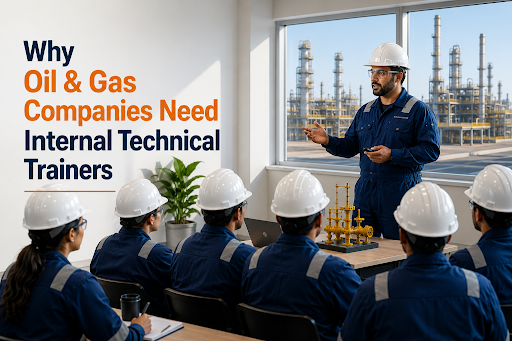
Working in the oil and gas sector involves being part of one of the most technologically challenging industries in the world. From the management of offshore wells to refineries and pipelines, everything that takes place in this industry involves meticulousness, regulatory compliance, and ongoing learning. As time progresses and the complexities of technology and risk grow, businesses have come to realize that relying on external workshops alone is not sufficient anymore. This is when train-the-trainer becomes increasingly vital.
Technical instructors working inside organizations can contribute towards building long-term competency through the training process. These people know the organization’s system very well, including safety practices, equipment issues, and the organizational dynamics, which an external consultant cannot have. This ensures that knowledge transfer takes place efficiently within the organization.
The Growing Skills Gap in the Industry
The skill gap in the oil and gas industry is one of the most pressing issues in the industry today. The experience gap in the industry is increasing since professionals retire, and new hires usually have little knowledge about the field. The digital transformation is also reshaping how things work in the industry.
Modern facilities now rely on:
- Automation systems
- Maintenance prediction technology
- Digital oilfield services
- Advanced drilling software
- Monitoring systems in real-time
If no technical training is structured, employees might find it difficult to cope with the changes. Trainers within an organization play a significant role in making technical operations easier to learn and understand for all employees.
Additionally, they facilitate smooth transition processes during personnel changes to minimize operational risks due to information loss.
Why Internal Trainers Create Better Learning Outcomes
Training providers external to the organization may provide relevant industry information; however, they may fail to have adequate knowledge about the operations of the company. Internal trainers are capable of delivering training sessions based on realistic situations in the workplace.
The advantages of internal training include the following:
- Relevance
- Practicality
- Consistency
- Cost-effectiveness
- Implementation becomes simpler
For instance, a technician at the refinery will learn more about shutting down from cases that happened at the same company as opposed to textbook examples that have no relevance to real life.
Technical trainers who have been employed internally may continue mentoring even after training sessions have been completed. An employee would be more willing to ask questions and clarify issues from someone he works with daily.
Safety Training Requires Continuous Reinforcement
Safety still ranks amongst the top priorities in the oil and gas industry. The impact of a simple mistake can cause huge problems in terms of operational processes, environmental issues, and finance. Moreover, compliance rules also change as time passes by, even in global markets.
Using internal trainers ensures that safety is consistently communicated and enforced rather than done in one-time safety training programs.
Some examples of areas in which internal trainers can make a difference include the following:
Process Safety Management
Team members will always need to be up-to-date about risk identification, hazard mitigation, and emergency preparedness.
Equipment Handling
Technical trainers may assist with practical training on equipment, drilling systems, and operational tools available to the company.
Regulatory Compliance
Regulations in the industry may differ depending on the specific project and regional requirements. Internal trainers will ensure employees stay within the required operating regulations.
Incident Prevention
Practical examples from experience shared by members internally will make it easier for employees to learn risk scenarios in practice.
For some companies, the train-the-trainer process becomes more efficient because employees start seeing safety as part of their regular processes, not just compliance.
Faster Adaptation to New Technologies
The energy sector is changing fast due to technological innovations, including automation, machine learning, remote working, and digital surveillance. Implementing these changes without appropriate training causes poor adoption rates and inefficiencies.
The use of internal technical trainers makes the transition easier for employees by helping them:
- Explaining system functionality in practical terms
- Conducting role-specific learning sessions
- Providing on-site troubleshooting support
- Helping teams adapt gradually to operational changes
As the internal trainers are familiar with the skills and processes within an organization, they will be able to break down complex concepts for employees without burdening them.
This is highly significant when an organization goes through major IT transformation projects that require high levels of workforce preparedness.
Building a Culture of Continuous Learning
Companies that provide for the technical training of their employees inside the organization are more likely to foster stronger learning environments. The workforce feels motivated whenever there is an avenue to increase their knowledge and skills.
Internal trainers can help an organization by providing:
- Higher levels of employee self-confidence
- Greater operational consistency
- Reduced dependence on outside providers for training
- Effective leadership development programs
- Increased cooperation between different departments
There is a growing trend among businesses to recognize potential leaders through technical mentoring programs. Engineers and supervisors who take up trainer roles tend to acquire new skills along the way.
This adds value to the organization apart from purely technical training.
The Importance of Structured Trainer Development
Every technical expert cannot become a skilled trainer. Expertise in the subject matter may be crucial, but there are other skills, such as effective communication, instructional design, and facilitation, which are equally vital.
Trainer development sessions assist technical experts in delivering:
- Technical data effectively
- Practical demonstration
- Learning outcomes measurement
- Adjustment of training techniques depending on the audience
- Knowledge retention in the workgroups
Companies that develop learning structures tend to have higher productivity and standardized operating procedures at all their locations.
This is why many corporations have turned to industrial training specialists to develop capabilities through training programs tailored to fit the specific needs of the industry.
Strengthening Operational Reliability Through Internal Expertise
Operational reliability highly relies on the effectiveness of knowledge sharing between employees in an organization. In cases where technical skills are confined only to selected few, corporations are prone to issues such as employee turnover and lack of uniformity.
In-house trainers help in creating consistency regarding operational information among various departments by making sure that best practices are shared at all organizational levels. This is especially true when it comes to working within international, offshore, or hazardous environments.
Today, several organizations are giving attention to other forms of development for their workforce, such as oil and gas development, technical competency development, industrial safety development, energy sector workforce development, and petroleum engineering development.
Organizations seeking to develop robust learning systems internally may find great value in train-the-trainer programs facilitated by industry experts. Industry specialists like Crewpetro have been known to assist in developing workforce capabilities through technical learning programs.