
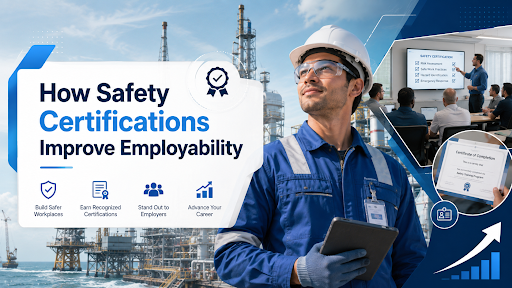
In industries such as oil and gas, employers need professionals who understand both their job responsibilities and the importance of working safely. Technical knowledge is essential, but the ability to recognise hazards, follow established procedures and respond appropriately to workplace risks can also influence career opportunities. This is where safety training and recognised certifications can play an important role. They help individuals develop relevant workplace knowledge while demonstrating their commitment to safer and more responsible operations.
For job seekers entering the industry, certifications can provide a stronger foundation before starting a new role. For experienced professionals, they can help refresh existing knowledge and support continued professional development. In a competitive employment market, relevant qualifications may help candidates demonstrate that they have invested time in developing skills that are applicable to the industry’s working environment.
Certifications Demonstrate Workplace Readiness
Employers often look for candidates who can adapt to the demands of their workplace with an understanding of basic operational and safety requirements. A relevant certification can indicate that a candidate has completed structured learning in specific areas related to their role.
For example, Crew Petro offers a range of training programmes related to well control, drilling operations and workplace safety. Its IADC RigPass programme covers a variety of important topics, including general safety, hazard control methods, personal protective equipment, hazard communication and accident prevention.
Completing a recognised programme does not automatically guarantee employment. However, it can help candidates present evidence of relevant knowledge when applying for suitable positions.
Building Knowledge Beyond Technical Skills
Many jobs in the oil and gas industry require employees to understand complex work environments. Personnel may work around heavy equipment, drilling operations, hazardous materials, and other situations that require careful planning and responsible decision-making.
Safety-focused certifications can help individuals become familiar with subjects such as:
- Hazard identification and risk awareness
- Personal protective equipment
- Permit-to-work procedures
- Emergency response
- Safe material handling
- Hazard communication
- Workplace conduct and responsibilities
- Basic first aid and CPR
- Behaviour-based safety principles
This knowledge can complement technical qualifications and provide candidates with a broader understanding of workplace expectations.
Greater Confidence in High-Risk Work Environments
Starting a career in a demanding industrial environment can be challenging, particularly for individuals with limited field experience. Structured learning can introduce participants to important concepts before they encounter them in a real workplace.
For instance, Crew Petro’s 30-day Roustabout & Floorman Training combines drilling knowledge, hands-on rig training, industry safety programmes and job-readiness elements. This type of learning can help participants understand how different aspects of rig operations are connected.
Training programmes that include practical instruction or simulator-based learning may also help candidates become more familiar with workplace scenarios. Crew Petro states that its training centres focus on small class sizes and simulator practice to provide candidates with greater individual attention and practical learning opportunities.
Recognised Credentials Can Strengthen a CV
A well-structured CV should clearly show an employer what a candidate knows and what qualifications they have completed. Relevant certifications can make it easier to demonstrate specialised training in areas that are important to a particular industry or role.
Depending on the course and the individual’s career goals, certifications may help highlight knowledge in areas such as:
- Well control
- General workplace safety
- Hazard identification
- Confined space awareness
- H2S awareness
- Crane operation and safety
- Permit-to-work procedures
- Behaviour-based safety
- First aid and emergency preparedness
Crew Petro provides several programmes in these areas, including IADC WellSharp, IADC H2S Awareness, IADC Confined Space Awareness & Entry, IADC Basic First Aid & CPR, and IADC HAZARD Identification & Risk Assessment (HIRA).
When listed accurately on a CV, relevant certifications can give recruiters a clearer understanding of a candidate’s training background.
Meeting Industry Expectations
Certain roles and work environments may have specific training or certification requirements. Candidates who understand these expectations before applying for positions may be better prepared to pursue suitable career opportunities.
The IADC WellSharp programme offered by Crew Petro, for example, provides different levels of training for professionals with varying responsibilities. The programme covers well control knowledge and role-specific skills for personnel ranging from introductory-level workers to drilling professionals and supervisors.
Similarly, the IADC RigPass programme is designed as a standardised safety orientation programme for drilling and workover personnel. Such programmes can help workers develop awareness of fundamental safety responsibilities across different operating environments.
By gaining relevant qualifications, candidates can better understand the knowledge expected within their chosen area of work.
Developing a Stronger Safety Mindset
Employability is not based only on certificates. Employers also value professional behaviour, communication and the ability to work responsibly with others.
This is why safety training can offer benefits that extend beyond passing an assessment. Effective learning can encourage individuals to think carefully about hazards, follow procedures and understand how their actions may affect colleagues and the workplace.
Crew Petro’s IADC Behavior Based Safety programme focuses on building a positive safety culture through observation, communication, feedback and participation. These principles can be valuable because workplace safety depends not only on written procedures but also on how consistently people apply them during everyday operations.
A candidate who understands the importance of safety and teamwork may be better prepared to contribute responsibly within an organisation.
Supporting Career Growth Over Time
Safety-related learning is not useful only for people seeking their first job. As professionals progress in their careers, they may take on new responsibilities that require additional knowledge and specialised qualifications.
For example, an individual may begin with introductory industry knowledge and later pursue more advanced programmes based on their experience and job responsibilities. Well control training, supervisory training and specialised safety courses can support professional development at different career stages.
Continuous learning can also help professionals stay engaged with current industry practices and maintain the knowledge required for their roles. Rather than viewing certification as a one-time activity, professionals can consider it part of their broader career development.
Connecting Training With Employment Opportunities
One of the practical advantages of choosing an organisation involved in both training and recruitment is the understanding it can offer regarding industry requirements. Crew Petro operates as a training and recruitment company, with a focus on the oil and gas sector.
Candidates can therefore explore relevant learning opportunities while developing qualifications that align with specific areas of the industry. However, individuals should always review the requirements of their desired roles and choose courses based on their experience, career objectives and applicable eligibility criteria.
Before enrolling in any programme, it can be useful to consider:
- The type of role you want to pursue
- Your current qualifications and work experience
- The eligibility requirements for the course
- Whether the certification is relevant to your career path
- The knowledge and practical skills covered in the programme
Taking a focused approach can help candidates select learning opportunities that genuinely support their professional goals.
Building a Safer and Stronger Career Path
Safety knowledge has an important place in industries where employees work in complex and potentially hazardous environments. Relevant certifications can help job seekers demonstrate workplace awareness, develop industry-specific knowledge, and prepare for the responsibilities associated with their chosen roles. While qualifications alone cannot guarantee employment, they can strengthen a candidate’s professional profile when combined with appropriate skills and experience.
For individuals looking to build relevant industry knowledge through recognised programmes, safety training can be a valuable part of long-term career development. With a range of oil and gas, well control and safety-related programmes, as well as experience in industry recruitment, Crew Petro is one of the best options to opt for when looking to develop practical knowledge and certifications that support employability.